
We are trying a few different approaches to how we structure our Tuesday evenings here at Northcote. How can we get the sort of input you get from a sermon (so that everyone has some knowledge about what is going on) but keep our discussion-y vibe, where everyone gets a chance to share?
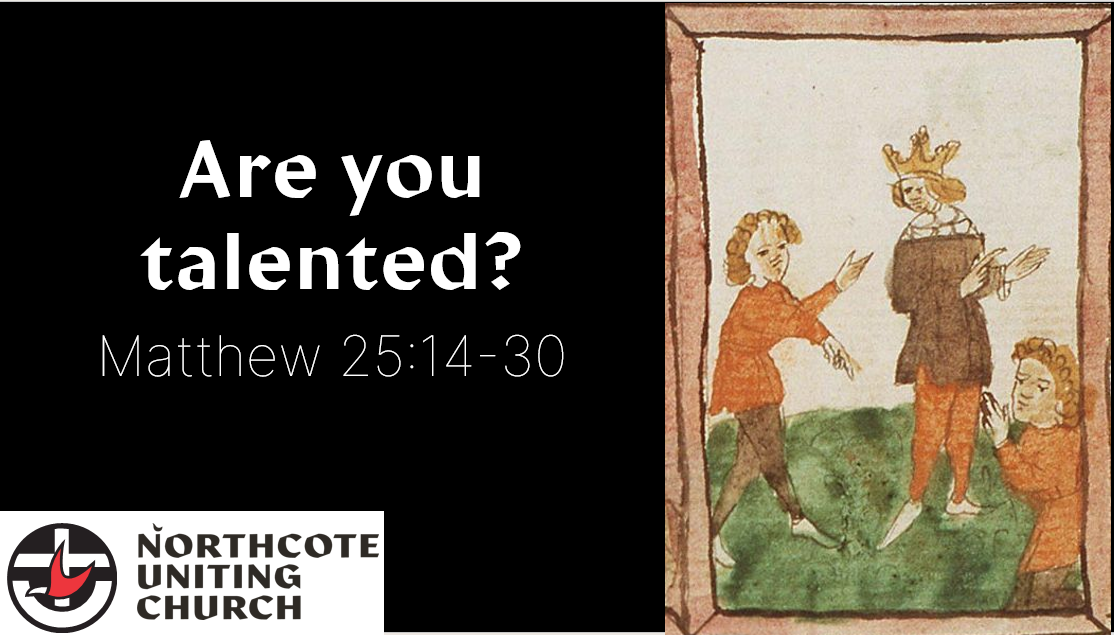
Here are the slides, saved as a pdf.
And here is a bit of a sermon.
The Parable of the Talents- Sermon Fragments
10/11/26
A couple of things strike me. Firstly, the “big bad thing”, which I think I will put off talking about until the end.
Secondly, here is the basic structure of the parable: there are three servants – really, two sets of servants. The bigger set, with two servants, are diligent. He leaves them with quite a lot of money really, five talents is seven million dollars, two talents is around three. They invest it wisely, and, by the time the master gets home, they have doubled their money. The master is pleased, and rewards them with more responsibility – “I will put you in charge of many things.”
We mentioned the Matthew Principle before – to those who have, more shall be given. To that we can add: the only reward for good work is more work.
So far, so commonsensical. Do good work, get rewarded.
But here is where it starts to get weird. As we said before, burying money in holes in the ground was a perfectly sensible thing to do in that context. If you think our banking systems are a bit unreliable and taxation can be punitive, just spare a thought for our ancient ancestors!
Which, incidentally, reminds me of my favourite anecdote about Samuel Pepys. During the Great Fire of London, when he had to flee his home, he made time to bury his most prized possession for safety. His wheel of parmesan cheese. I can’t quite recall whether he was able to extract it back again, but it is always a pleasure to encounter someone who takes their food that seriously.
Anyway, as we said earlier, burying hordes of money all over the shop was perfectly normal, rational, safe behaviour.
So, surely the master will reward him for his sober, risk-averse, careful attitude to the riches that were entrusted to him? After all, even though he didn’t double his money, at least he got it back again, and it wasn’t lost in stock market fluctuations.
However, shockingly, the servant is punished for his lack of initiative, and his talent is given to the person who had ten talents – that’s the Matthew principle again.
Does that feel unjust to you?
Well it did to the ancients, and we know that because of a version in a non-canonical book known as the Gospel of the Nazarenes, which alters the story so that the third servant essentially spends the money on hookers and blow, and is punished for his wicked behaviour. That seems like a more morally satisfying denouement.
It’s a bit out of fashion to comb through the Gospels looking for what Jesus did or did not authentically say – feel free to ask me about the Jesus seminar and their coloured marbles later – but I’m going to be a bit old fashioned.
This bowdlerised version is not what Jesus said, and the reason we know that is something called the “criterion of embarrassment.” Which is, roughly, this is so weird, and embarrassing for all concerned, that Jesus must have said it.
We are all tempted to want Jesus to tell us nice, systematic, morally uplifting stories. Like Victorian school teachers, we would really rather not have all this moral complexity.
And, to make it worse, Jesus absolutely doubles down on it. The servant, suspecting that he might be in trouble, attempts a very surprising defence:
'Master, I knew that you were a harsh man, reaping where you did not sow and gathering where you did not scatter, so I was afraid, and I went and hid your talent in the ground. Here you have what is yours.'
I am not at all sure how that was supposed to help. It’s one thing to let the boss down – but then to attempt to insult him? Maybe it’s one of those things that made sense in context, some sort of flattery – “you are dread lord of whom all are rightly afraid, you smite your enemies with a steel fist” sort of thing? If so, it is an attempt at flattery that does not work. As we said, the master gives the servant’s talent to the one who had ten, and casts the first servant out into the outer darkness, where there is “wailing and gnashing of teeth.”
So, here is a first thought about the passage: it is intended to praise the servants who show some initiative, who use their talents on behalf of the master. That’s why we use the word “talent” to talk about our “gifts and graces”, rather than a unit of currency.
This is why it’s important to see where the parable fits in the overall narrative of Matthew’s Gospel: it comes between the “little apocalypse”, and ends with the only “last judgement” scene in the New Testament, so it seems most likely that it Matthew was concerned with talking about how Jesus’ disciples should behave in the time between Jesus departure in the Ascension, and his return.
There is a lot to unpack there, but we won’t, because I want to come back to my first point about the Big Bad Thing.
What does this passage in fact say about God? It makes God look like a terrifying tyrant -after all, the master doesn’t disagree with the servant’s assessment of him. He admits that he does indeed reap where he does not sow and gather what he did not scatter.
If that were the only picture of God in Scripture, that would indeed be a terrible thing.
However, Scripture is also full of pictures of a merciful God. For instance this Psalm, which Jesus would have been familiar with:
The Lord is gracious and compassionate,
slow to anger and rich in love.
The Lord is good to all;
he has compassion on all he has made.
Psalm 145:8–9 (NIV)